

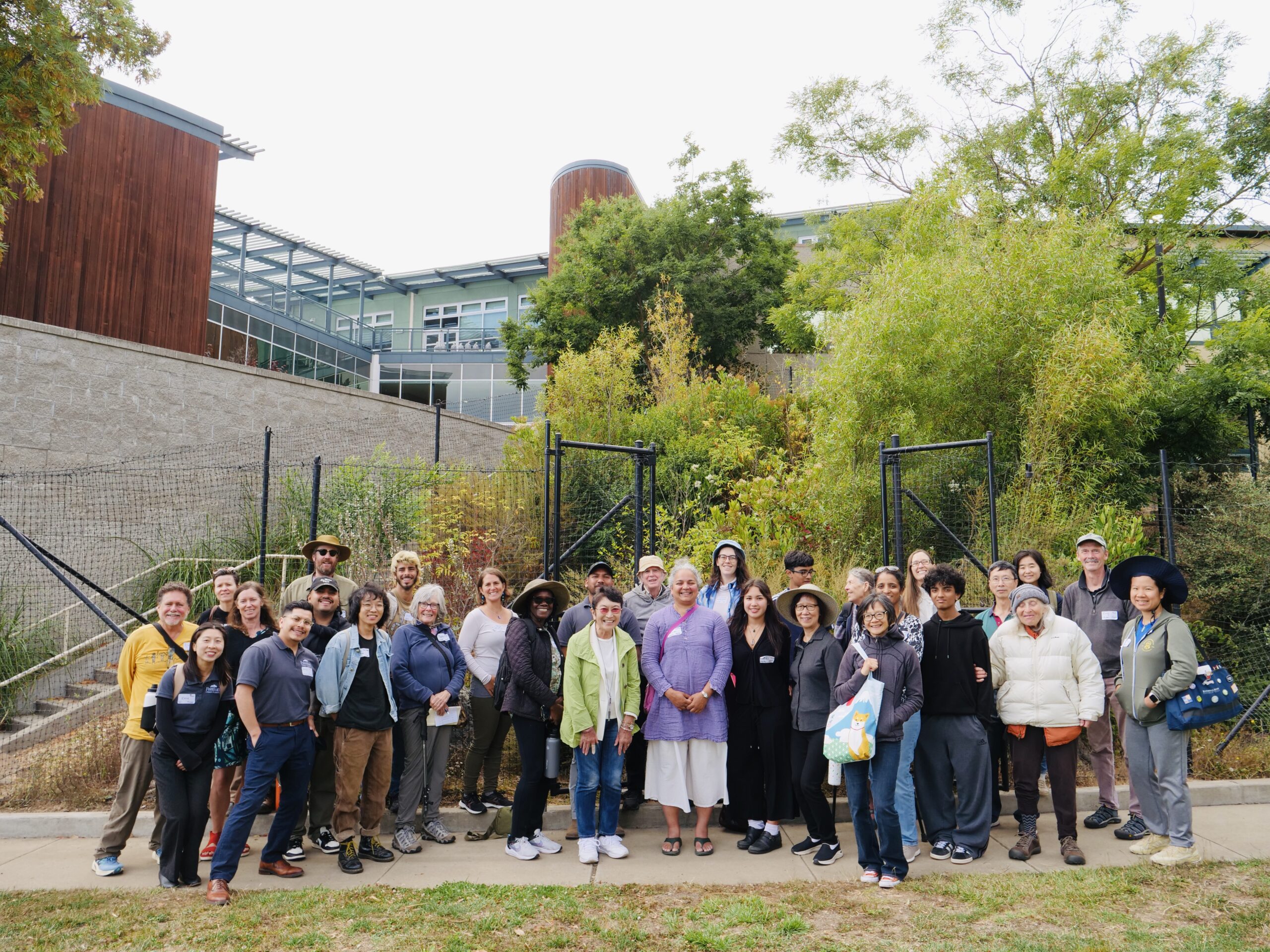
This past July, Yokohama-based professor Kazue Fujiwara visited Berkeley, California for a very special symposium celebrating her work and that of her mentor, the late Dr. Akira Miyawaki (1928-2021). Fujiwara is a professor emerita of Yokohama National University; following her retirement there, she continued working at Yokohama City University. Her work with forestation projects—notably Miyawaki Forests—is helping to ensure that our planet remains habitable. At the very least, as this symposium proved, Miyawaki Forests are providing comfort and purpose to a generation of youth.
Before discussing the symposium, where children shared their experiences with Miyawaki Forests, let’s take a look at this phenomenon. The forests are actually dense, biodiverse pockets on small plots of land featuring native, fast-growth plant species. The forests are the result of a reforestation technique called the Miyawaki Method, developed by Dr. Miyawaki in the 1970s. Dr. Miyawaki was a botanist and professor emeritus at Yokohama National University whose influence in this field of natural forest restoration spans the globe.
Dr. Miyawaki’s method drew from observations of temples, shrines, and cemeteries in Japan where plants and tree species differed from public forests featuring species like cedar. He surmised that the former were remnants of older forests, while the latter were introduced later for the purposes of forestry and timber. He concluded that this shift was not ultimately beneficial, and that by restoring the original vegetation, there would be improved environmental conditions.
The Miyawaki Method thus involves replicating the natural vegetation of a plot of land with multiple species—as many as several dozen—instead of ornamental trees or a single species. They are planted close, creating competition and faster growth. Only organic matter may be used as fertilizer. According to some estimates, Miyawaki forests grow as much as ten times faster and can be nearly thirty times denser than planting methods traditionally used. Within just a few decades, they can be nearly indistinguishable from mature natural forests that in other circumstances can take a hundred years or more to regenerate. Due to the biodiversity, an array of insects, birds, and small animals may additionally call the forests home.
The Miyawaki Method can work on large swaths of land, but most associate it with smaller areas, whether that be a few hundred square meters in an urban environment or—as in the case of Berkeley—small plots on school grounds. In urban sectors in particular, they help mitigate heat islands. They also sequester carbon, improve soil and groundwater conditions, and are visually appealing. Shouldn’t we be seeing these everywhere? That’s the goal of its many advocates, including professor Fujiwara.
Fujiwara is a protege of Dr. Miyawaki, and considered the leading authority on the Miyawaki Method today. She worked closely with her mentor for decades, even helping to refine the scientific principles behind his work. In fact, she took over his position on his retirement. She’s a tireless advocate who travels the globe, encouraging communities to engage in restoration projects. Her own work is in global vegetation science, including temperate deciduous forests, wetland vegetation, and coastal vegetation. She is additionally focused on vegetation in cities, which touches on environmental planning, land management, and restoration. Her summer visit to Berkeley was thus a welcome one, and yet another stop of the many she has made in communities from China and Southeast Asia to Africa and Europe.
Why Berkeley?
The Berkeley symposium took place at King Middle School, one of the area’s several homes to a Miyawaki Forest, thanks in large part to the efforts of Ms. Neelam Patil. A climate literacy and science teacher in the California public school system, she was named a Time Magazine Teacher of the Year in 2022 for encouraging children to take action against climate change. One endeavor could be planting a Miyawaki Forest on school grounds.
Neelam was behind the planting of Miyawaki schoolyard forests in Berkeley—a first in North America. Her efforts were also part of the City of Berkeley’s legislation to plant the first Miyawaki Forest in the city itself–she was helped by a group of students who attended the city council meeting to advocate for funding.
The symposium was open to public school teachers, students, city politicians and employees, school board members, local residents, and community volunteers. While its most illustrious speaker was Fujiwara, there were others of note. Beyond Fujiwara and Patil, that included Dr. Elgene Box, professor of ecology for four decades at the University of Georgia. He first met Dr. Miyawaki in Argentina in 1983 and has incorporated the Miyawaki Method into his own work. Another was Hannah Lewis, the author of Mini-Forest Revolution. And finally, there was Angelina Lee, an L.A.-based filmmaker who has created a feature-length documentary about movements around the world to plant Miyawaki Forests.
The biggest stars were the youth themselves: elementary and middle school students who had originally planted the Miyawaki Forests at their schools. In a special panel talk, they took the stage to discuss their reflections on planting the forests and their feelings several years later, now that the small plots of land are growing into their own. The revelation for many of the attendees was the great comfort and peace that the forests gave to the students.
The environmental benefits of Miyawaki Forests are well documented. We now understand their mental impact on youth. By all accounts, the forests give them a sense of hope: that they can take action and change the world for the better, even if it is one small plot at a time. Several of the students eloquently expressed how this experience has given them inspiration to take further action. Who knows where this will lead; it seems safe to say, however, that Fujiwara has more than a few young fighters to carry her work forward, just as she did for Dr. Miyawaki.
This is the first of a two-part series on this topic; join us next issue for an interview with Professor Fujiwara and others involved in the efforts. Ry Beville, the founder of the Yokohama Seasider, is a lecturer on Japanese studies at the University of California, Berkeley and was in attendance at the symposium. His daughter, Kylie, who was born in Yokohama, was one of a group of youth that petitioned representatives at the Berkeley City council meeting for funds for the city’s first Miyawaki Forest.