

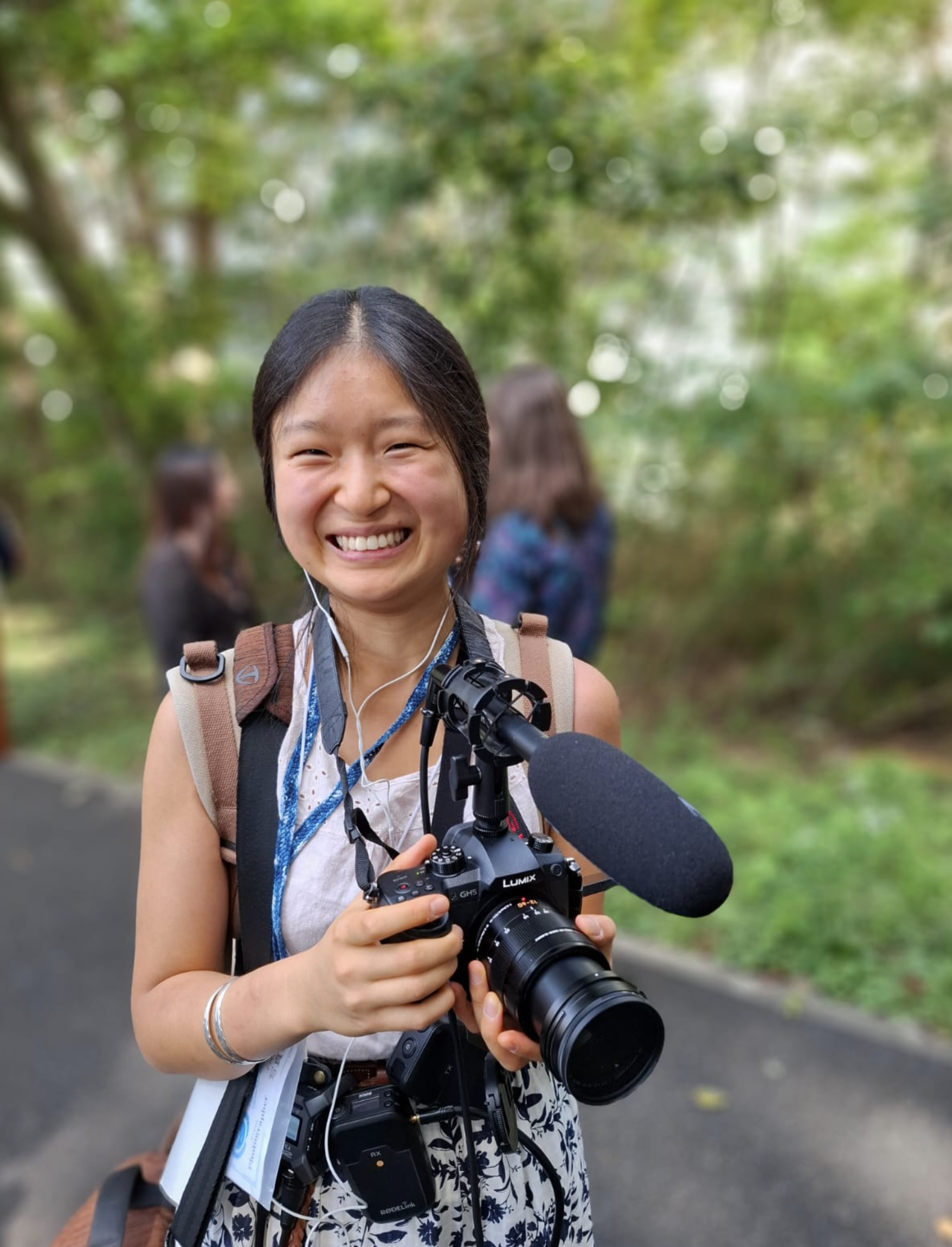
Angelina Lee is an L.A..-based independent filmmaker who recently shot and produced a documentary about the Miyawaki Method.
Please tell us more about your film.
It’s called Making a Mini-Forest. It’s about the renaissance of Miyawaki forest planting over the last five to ten years in Europe. This film specifically focuses on a network of tree planters that share knowledge, resources, and ethics–much like the interconnected underground root network of a mature forest! I was touched by this blossoming example of how one person can make a difference. One person inspires another, and another, who then takes mini-forest planting to their own town and country. The film tries to capture that. In the same vein, it also explores the origins of the Miyawaki Method in Japan fifty years ago, and its continued, thriving application in projects there. The film is 81-minutes long, and was filmed in France, the United Kingdom, Belgium, Germany, the Netherlands, Japan, and the U.S.
How did you learn about the Miyawaki Method and connect with Prof. Fujiwara?
I first learned about Miyawaki forests through award-winning American author Hannah Lewis’ book, Mini-Forest Revolution. I recommend that everybody read it! I knew nothing about the specifics of tree planting beforehand, and that book single-handedly convinced me that planting forests is arguably one of the most powerful efforts we can make against climate change. I was already in Europe when I read about tree planters like Boomforest in France, and started to meet people and see mini-forest plantings. I realized this could be a longer film so I contacted Hannah to be a part of the film. She is the narrator, and has immeasurably enriched it as a result. She was already in contact with Professor Fujiwara and kindly connected me to her.
It seems the film will be screened in Japan (with Japanese subtitles)…
Yes, it will have its Japan premiere on Sunday, December 28th, at 13:30 in the Lecture Hall of the Yokohama Museum of Art! Since Japan is the birthplace of Miyawaki mini-forests, it’s an honor to be able to show the film there. I hope that the film can testify to just how impactful the Miyawaki Method has been around the globe.
Where have you seen Miyawaki projects thrive during your travels for the filming?
Everywhere! There are Miyawaki forests on every continent except Antarctica. I’m slowly but surely trying to travel to as many sites as possible and produce high-quality photo documentation that captures that moment in time for the forest. But I was fortunate to take part in, and document through a 10-minute video, the first International Symposium on Miyawaki Forests last year at Yokohama National University. This was sponsored by the United Nations G20 Global Land Initiative, and forest makers from twenty-eight countries presented their findings.
Please tell us a little about yourself: your background, what other kinds of films you’ve shot, etc.
I’m an environmental filmmaker who focuses on solutions–the remedies we already have to replant indigenous forests, reconstruct biodiversity webs, clean our air, heal our food systems, and more. The first feature film that I directed, The Big Raise, is about a small permaculture farm in France that practices new ways to grow food while actively repairing the soil. Making a Mini-Forest is my second feature and the first in a planned series of global Miyawaki films.
Thank you Angelina and good luck!
(Visit her website at: punkpebble.com)