

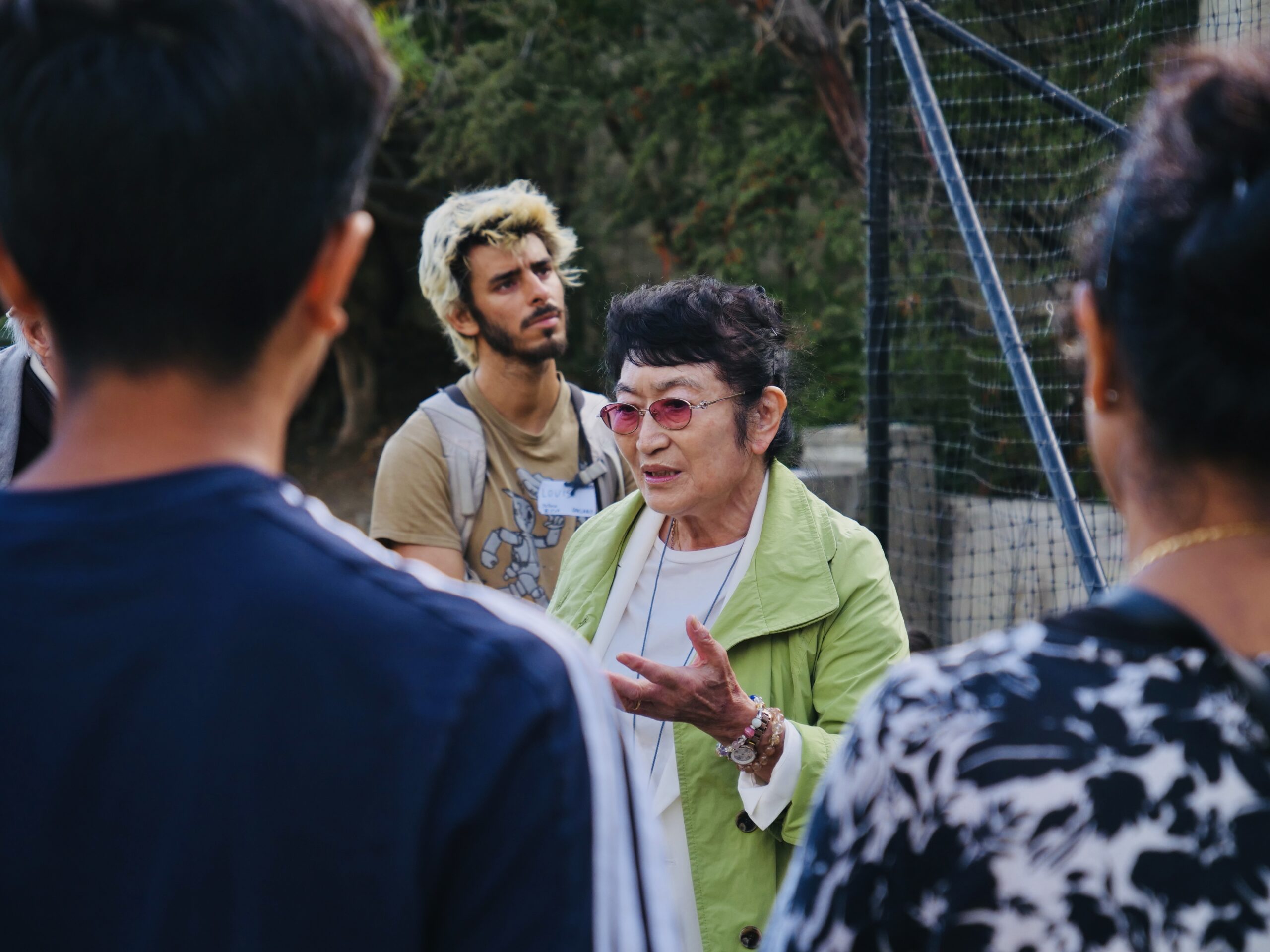
We introduced Yokohama’s own Professor Kazue Fujiwara in the previous issue of the Yokohama Seasider, detailing her work in the context of the Miyawaki Method for forest development, which is becoming a worldwide phenomenon (download a free pdf of the magazine if you missed it: www.yokohamaseasider.com). Here, in the second part of the feature, we interview her directly.
Can you please tell us how you got into this line of research and professional work?
When I was doing research for my undergraduate thesis topic (“Changes in Peat Bog Vegetation Due to Human Impact”) assigned by Professor Miyawaki, I found that everyone believed peat bogs were entirely natural, that no one in the world had studied this before, and that my work was a new discovery. That experience was what first drew me to the relationship between nature and humans. I was told, “You’re a girl, so you should study something like pretty flower fields.” That’s how I was assigned the topic, but it marked the start of my lifelong connection with plant ecology.
Please tell us about your relationship with Professor Miyawaki. What were some of the valuable lessons he taught you?
I learned so much from Professor Miyawaki: 1) I developed the ability to truly see nature. I can look at green environments and tell whether they are natural or influenced by humans, not just in Japan, but wherever in the world I go. Moreover, I understand what kind of human or animal influences have shaped those spaces. 2) Instead of restoring forests everywhere, we should plan green environments suited to their specific purposes. 3) If an area that was once forest is now degraded land, we can still restore the forest. 4) The “rules” of plant communities (plants endure, compete, and coexist) apply directly to human society as well.
You are now the torch-bearer of the Miyawaki Method. At the same time, what are your own unique contributions to this tradition? After all, you have your own fields of research.
With my graduate students, I’ve worked to clarify aspects of the Miyawaki Method, including what percentage of trees survive over time, and what new species begin to form the composition of the new forest after taller tree species are planted. As for my own research, it focuses on studying natural forests that regenerate on degraded lands after forest destruction, both in Japan and around the world. Thus, wherever I go, I first identify what constitutes a natural forest in that region, and then work with locals to develop methods of forest creation suited to that environment.
As a teacher, what are some of the most important points you emphasize with your students?
I try to help them understand why the vegetation (greenery) right before their eyes exists as it does, and then develop that understanding into a broader awareness of commonalities between Japan and the world. I hope they will think about issues such as global warming, abnormal weather, and natural disasters. I want them to reflect on what they can do personally.
Please tell us about some of your unique experiences traveling the world.
Under Professor Miyawaki’s leadership from 1977 to 1979, we conducted a detailed survey of mangrove forests in Thailand. Wading chest-deep through water, pushing through muddy ground toward the mangroves, then walking across the tangle of roots like the stilts of fiddler crabs were experiences that gave me an intimate understanding of mangrove forests around the world. I have many memorable moments from my graduate field research. Once, while looking up to study tall tropical trees, I accidentally stepped into a nest of army ants and howled from the pain. During a tundra project, I was astounded to see peat bog plants growing together with alpine species. There were mosquitoes, too–so many that our backs turned black as we swatted them off each other with our gloved hands, only to have our Russian colleagues tell us we were “destroying the ecosystem.”
Where have you seen the biggest successes with the Miyawaki Method? And why?
In ‘industrial deserts’, forests have regenerated around factories, becoming places of relaxation for workers. Students have planted trees around schools and monitored the growth of the forests themselves (though nowadays teachers seem too busy to provide such guidance). On degraded lands in places like Nepal and Kenya, where people once said “nothing will grow,” forests have returned within just five years. There are even “green seawalls” now–forests that help reduce the impact of tsunamis. The reason for these successes: Using native forest species, young seedlings with well-developed roots from having been in pots are planted closely together with different species mixed in randomly. Because each plant grows differently, they compete for sunlight without hindering each other, performing photosynthesis efficiently and growing rapidly. Dense forests thus form more than twice as fast as those planted with wide spacing, where each tree requires individual maintenance and grows more slowly as it thickens. Of course, in the Miyawaki Method, prior to planting, the soil is prepared to mimic natural forest soil—well-drained and enriched with moderate nutrients. Even in small areas, such dense plantings can grow into young forests within five to ten years. By creating a well-drained, nutrient-rich base, it’s possible to restore forests even on barren land.
Where do you see this work and related research going? What are some of the new avenues of exploration/research?
By incorporating it into urban planning, architecture, landscape science, and forestry, the Miyawaki Method can help address environmental pollution, global warming, abnormal weather, and disaster mitigation.
Children in particular seem to find hope and satisfaction in becoming involved in Miyawaki Forests. Why do you think that is?
Children are, in a sense, planting life into the earth when planting saplings. The act of touching the soil, feeling the breeze, and being warmed by the sun allows them to experience the joy of planting through all their senses. And by working together to weed and monitor growth, they can directly observe the forest’s development—watching soil-dwelling creatures, insects, and birds, and comparing the temperature within the forest to that of the bare ground outside. These experiences help them understand forest development, biodiversity, and ecosystems in a tangible way.
What can our readers in Yokohama do to help or organize their own activities?
In Yokohama, there is a system to support civic and community activity. Through the “Community Green Town Development Project,” local communities can submit plans to introduce greenery suited to their area—whether residential neighborhoods, shopping streets, office districts, or industrial zones. Grants are provided to promote greenery through citizen collaboration. Under the “Human Resource Development Project for Forest Nurturing,” the city, in cooperation with citizens and businesses, provides necessary support to organizations engaged in forest cultivation activities. Grants are awarded to those carrying out active forest-related initiatives. For readers in Yokohama, there are opportunities for volunteers to come together, consider what can be done in their local area, and put those ideas into action. Give that a try first. Then join in forest-cultivation activities taking place all over Japan—even around the world. Once you take part, you may discover a new part of you.
Thank you Professor Fujiwara!